

Factors Driving Femicide: Why and by Who Are Women & Girls Threatened with Violence?

A look into the cultural systems of violence that drive femicide.
By Anusha, Rachael, Nandini & Ekin
UN Women defines femicide as the “intentional killing of women with a gender-related motivation”. This term applies to the murders of women and girls who were killed over sexist reasons or stereotypes. We took a deeper look into these reasons and stereotypes to trace the types of sexism that drive femicide. We did this by asking female and assigned-female-at-birth participants to share their experiences of being threatened by femicide and gender based violence in general, since femicide is usually driven by or the product of such violence. Our findings have brought some reasons and patterns to light that are used as justifications for femicide and anti-woman violence in general. As with any other issue, we need to fully understand the roots of femicide in order to eradicate it. This research project hopes to contribute to that.
Participants
Even though our sample size of 80 was modest for such a widespread issue, we believe that the diversity of our participants adds value and reliability to our findings. We had respondents from India, Turkey, United Arab Emirates, Iraq, Kazakhstan, Nigeria, Australia, Austria, Croatia, England, France, Germany, Greece, Pakistan, Romania, Italy and the United States of America. 76% of our participants were of either South Asian or Middle Eastern origin. They were aged from 15 to 35 years old, with 25 being the average age. In order to include all of those who are threatened with femicide, our survey was aimed at women, girls and anyone who was raised as a girl even if they aren’t one. This included some transgender men and non-binary people who were assigned as female at birth. 81% of the participants were working class (do salaried work for their own survival or financially depend on someone else who does salaried work for a living).
How Many Received Threats of Violence and Why?
69% of the participants reported having received threats of gender based violence, while 31% reported receiving no threats of such violence.
Out of those who did experience these threats, 58% were threatened with physical violence such as being beaten or slapped, 18% were threatened with murder (femicide itself). The others also reported threats of emotional, verbal and sexual abuse.
A key part of our research was looking into the misogynistic mentality that is driving violence against women through looking at the reasons why women are threatened with such violence. Our participants reported receiving threats of gender based violence for the following reasons:

Due to dating (36%): Premarital relationships or being accused of such relationships led to threats of violence and murder against women. A few even shared stories about receiving such threats due to having male friends while there was a double standard with male siblings who weren't held up to that clothes.
Due to wearing a certain kind of clothes (45%): Women and girls reported receiving threats for wearing clothing that goes against the narrow social norms for women. A few even shared experiences of facing backlash for clothing deemed unfeminine.
Due to behaving in any kind of way that is seen as immodest (39%): Any behavior perceived as immodest led to threats of violence and femicide.
Due to being queer (16%): Queer women faced threats of violence for their sexuality and for defying heteronormative norms.
Due to rejecting a suitor for an arranged marriage (5%): Marriage is often seen as obligatory for women. A few reported receiving violent threats for rejecting suitors.
Due to being accused of dishonoring the family (39%): A lot of the participants were from South Asia and the MENA region, where honor cultures are very common. Girls and women reported receiving threats by family for behavior violating social norms that is deemed as dishonorable.
Due to being blamed for your own sexual assault or sexual harassment (35%): Along with being blamed for their own sexual assault or sexual harassment, some female survivors reported being threatened with violence due to their perceived role in it.
Due to jealousy experienced by a partner (20%): Partners of some participant threatened them with violence due to feelings of jealousy and possessiveness.
A smaller number of participants reported other reasons being threatened with violence like for needing mental health support, their academic performance or for not following religious obligations.
Clothing choices, dating and accusations of “dishonor” being the most commonly mentioned reasons behind these threats showed us the connection of honor based cultures to gender based violence.
Out of those who experienced threats of gender based violence, most reported being given these threats by their immediate family and those in positions of authority.
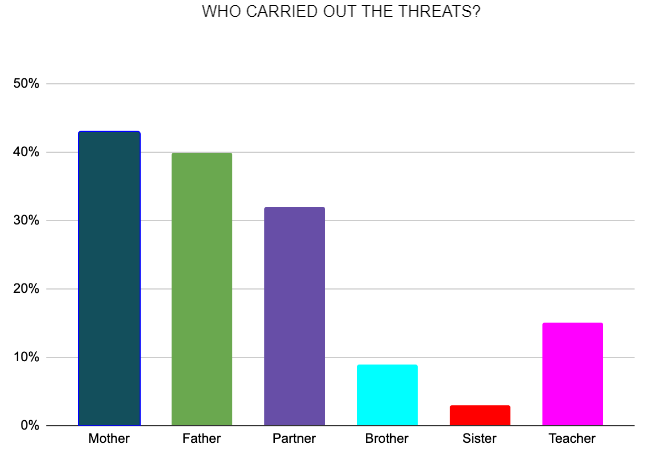
Graph showing who threatened the female participants: Mother(43%), Father(40%), Partner(32%), Brother(9%), Sister(3%), Teacher(15%).
A smaller number of participants mentioned by others like coworkers, classmates, stepparents, friends and male strangers.
As other research on gender based violence has established, we saw that women and girls experienced the highest threats of gender based violence at home (by parents, family members or partners) and at school (by teachers).
How Many Experienced Gender Based Violence?
Out of those who experienced threats of gender based violence, 30% reported that the threats got physically acted on them.
Here are some of the experiences that were shared (Content Warning for descriptions of violence and abuse):
“Beating up was fairly common, restricting mobility, taking away TV/ internet/ landline access.”
“Got slapped and hit for coming home late, dressing in a way they don't like ( I'm queer and prefer to dress in a masculine way which they dislike), hanging around with people who were out and proud as queer.”
“Brother saw me texting someone, went off the rails because he was ‘sick of me talking to boys.' Keep in mind, he's had a romantic engagement in the past though, and has also sexually interacted with girls online on sites like Omegle. He manhandled me. The next morning, he shoved me in the chest unprovoked and then thrashed me with repeated punches in the head. This has happened 3 times again and I realized that he very shrewdly took care to only punch my head as bruises on the face would make people worried about me. In all of this, no one in the family really did anything of substance. I know for a fact that the first time he assaulted me, it was encouraged by my misogynistic uncle and grandmother.”
“My mother would hit me if I wore anything she didn't approve of. She still berates me for my clothing choices.”
“More than half of the physical violence threats were carried out, only the threat of killing has been verbal and exaggerated.”
“A friend who happened to be a guy (before we started dating) sent me a text message and my parents saw it. My father slapped me really hard and kept threatening to marry me off to someone or send me to a religious school where I would not be allowed any electronics or books except religious literature in the religion they practice. (I am an atheist).”
“My mother smacks me all the time. I’m in an interracial relationship that she doesn’t approve of and she hits me - slaps, punches and with anything she can find in close proximity. And she makes sure to hit my face so it’s visible.”
“Physically beaten by mother and step-father for being bisexual, speaking about the abuse I experienced, wearing clothing I enjoy instead of clothing they choose for me, dating, for being sexually assaulted, among many other things.”
We saw that sexist ideas of ownership over women and queerphobia are one of the biggest causes of violence against women.
Partner Violence
Since family and partners are the main perpetrators of femicide, we decided to also look into intimate partner violence. 27% of participants reported experiencing violent threats after rejecting the romantic advances of men and 18% of the participants reported having experienced physical abuse by their partners. Jealousy and possessiveness were common reasons.
Pattern in Abusive Behavior
Out of those who experienced abusive behavior of their partners, 87.5% reported that the behavior was repeated even after apologies. We believe this is an important pattern to highlight so that women and girls plan for their safety at the first sign of abusive behavior, instead of giving chances to their abusers which lead to more severe forms of gender based violence like femicide.
Conclusions
We saw that the majority of women, girls and other people raised as females have experienced threats of gender based violence. These threats often got carried out as well. If threats of common forms of gender based violence get carried out, it seems reasonable to assume that the same must apply to femicide. Gender based violence is motivated by sexist ideas of ownership over women, homophobia and honor culture. We have observed that both partners and family members felt this abusive ownership over women. In partners, this sense of owning women was displayed as romantic jealousy while family members saw women as objectified carriers of honor.
We can conclude that in order to crush gender based violence at its root and consequently femicide itself, we need to destroy the idea that women are property to be controlled by their families or partners. We must also actively fight against gender norms that motivate others to believe this. Organizations fighting against gender based violence and femicide can create educational programs and campaigns targeted at the family members, partners and authority figures in women's lives. The view of women and girls as objects needs to be crushed through education and wider restructuring of society.
Comments